
Types of aquaculture farms

Today’s consumers want to be informed. They want to know the origin of products they buy.
The latest reports confirm an increase in fish and seafood farming at levels that already exceed fishing sector. For this reason, we continue with our series of articles on aquaculture. In this case, on aquaculture farms – areas where aquaculture species are grown.
What are aquaculture farms?
Aquaculture farms are facilities dedicated to the breeding and farming of fish, shellfish and algae in a controlled environment. These farms play a crucial role in sustainable food production and in reducing pressure on wild populations.
In addition to contributing to food sustainability, they support economic development by generating employment and use of technologies that improve efficiency and production.
Types of aquaculture farms
The aquaculture sector grows alongside fishing for decades. Thanks to gained experience and implementation of new technologies, the sector becomes more environmentally friendly. This progress is reflected in increasing number of types of aquaculture farms. Moving from extensive to intensive farming, from offshore farms to land-based facilities.
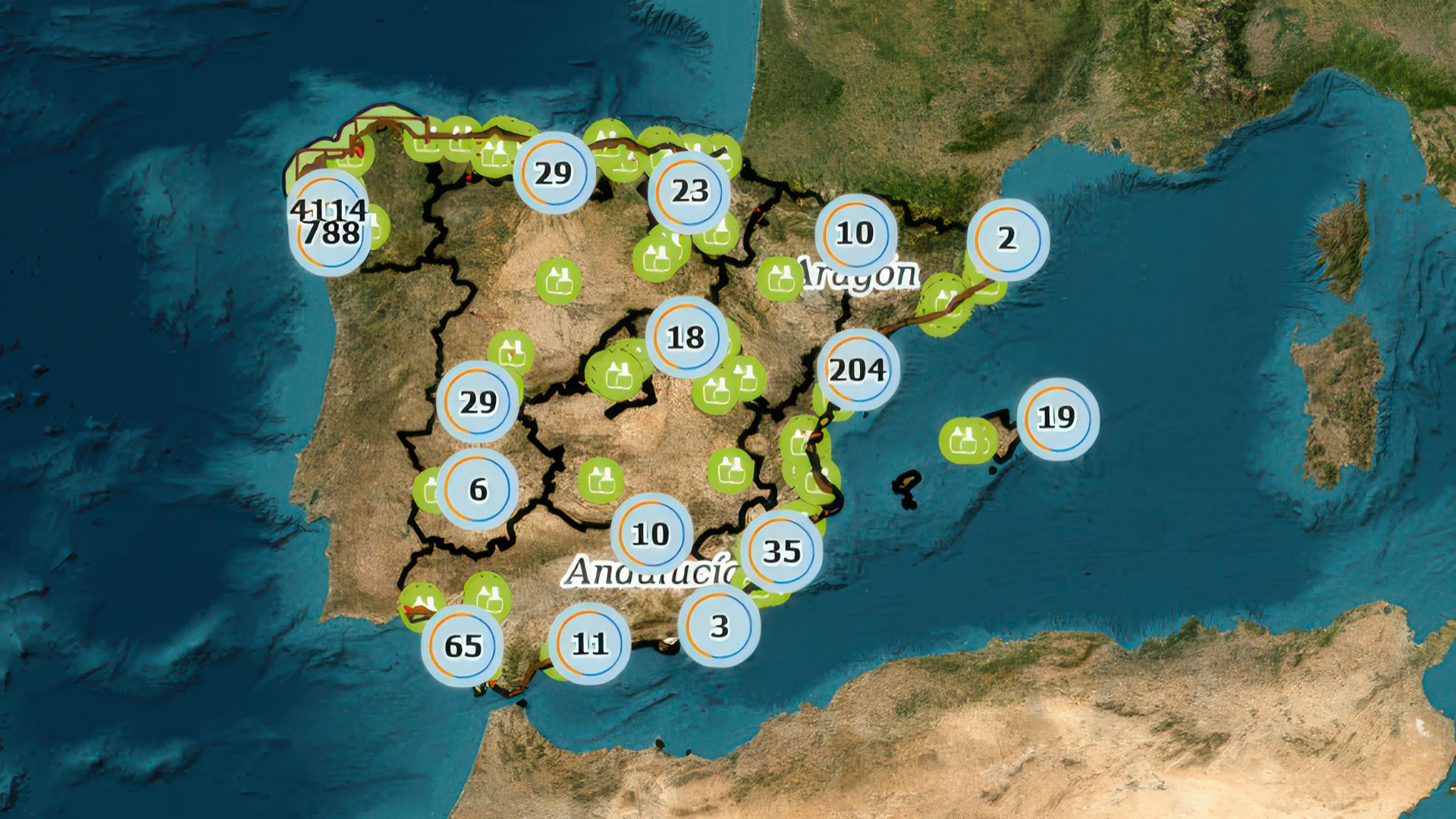
Map of Aquaculture Farms in Spain
Aquaculture farms by life stage
Cultivating fish and crustaceans is a rather complex process. Considering that some types of fish are used to reproduce in fresh water, but grow and live in salt water, each phase of growth therefore requires specific conditions to ensure an ideal environment and animal welfare. Thus, we differentiate between:
- Broodstock – where the broodstock is located. It guarantees a constant and high quality supply of fry or larvae.These farms usually have specialized facilities for the reproduction and care of the eggs until they hatch.
- Hatchery – At this stage the eggs are transformed into larvae, which are fed by phytoplankton, rotifers, artemia and/or dry feed microdiets.
- Pre-growing or nursery – This stage focuses on raising fish from the fry stage until they reach an intermediate size, before being transferred to the grow-out farms.
- On-growing – The last stage focused on the growth and development of the fish until they are ready for harvest once they have reached a commercial size for consumption.
Aquaculture farms according to the type of water
Marine farms
These facilities are used to the breeding and cultivation of fish in controlled marine environments.
These farms are located in coastal waters, such as oceans, seas, estuaries and bays. They use floating cages or open flow systems on land.
Freshwater farms
These farms dedicate to the breeding and production of fish in freshwater environments.
These farms are located in rivers, lakes, ponds, streams, etc., although with RAS systems they can be installed anywhere. They can use open flow tanks or RAS (closed circuit aquaculture production systems) on land.
Aquaculture farms according to the location
- Land-based farms- We speak about marine or freshwater farms, mainly in tanks or ponds, and depending on the species, they can cover all stages of the fish’s life.
- Sea-based farms- These marine or freshwater farms, mainly in floating cages, are focused on fish pregrowing phase and ongrowing. The format of the facilities can vary. From tanks, ponds to horizontal cultivation.
Aquaculture farms according to water flow
RAS (recirculation)
The abbreviation RAS stands for Recirculating Aquaculture Systems. It is a water recirculation system with technology that allows the reuse of water that has already been used, by constantly circulating it through a closed system. This process can include several stages, such as treatment, filtration and disinfection of the water, before reusing it.
- Environmental control
- Water efficiency
- Reduction of environmental impact
- Initial costs
- Maintenance
FTS (open flow)
An open flow system uses a continuous flow of fresh water from the natural environment, such as rivers, lakes or the sea.
- Lower initial cost
- Natural conditions
- Limited control
Grow your business with innovative feeding systems.
Start improving your profitability today.
From land-based fish farms to offshore systems, Fish Farm Feeder develops automated solutions tailored to every environment. Our technology enhances operational efficiency, optimizes resources, and maximizes your business profitability.