FishFarmFeeder’s AI-Powered Grader Solution

Smarter Flatfish Grading Starts Here
In modern aquaculture, precision, speed, and traceability are becoming essential. As hatcheries and nurseries scale up production, grading operations must become more consistent, more efficient, and more data-driven. This is exactly where FishFarmFeeder’s FLATCLASS solution creates real value.
FLATCLASS is an advanced grader for flatfish juveniles that combines machine vision, intelligent data processing, and automated biomass estimation to classify fish according to size and provide accurate production insight at the individual level. It has been designed to help producers improve grading consistency, optimize batch management, and gain access to valuable biological and operational data in real time.
A grading solution built for modern hatcheries
FLATCLASS is not just a machine for separating fish. It is a complete smart grading platform designed for industrial aquaculture environments.
The system features four independent grading channels, each capable of processing 10 fish per minute, delivering a total throughput of up to 40 fish per minute. It is designed to handle flatfish juveniles with a maximum width of 12 cm, making it suitable for demanding production workflows where speed must go hand in hand with precision.
For every fish processed, FLATCLASS records:
- Length (mm)
- Width (mm)
- Estimated weight
This gives producers a much richer picture of stock condition than traditional grading methods. Instead of relying only on category output, they gain access to unit-level data that can be used for monitoring, traceability, and decision-making.
How FLATCLASS Works
FLATCLASS has been designed to fit naturally into the day-to-day workflow of a hatchery or nursery operation. Before the grading process begins, the user carries out an initial biological calibration by running a representative sample of fish through the system. Typically, this calibration stage is performed with around 200 juveniles, allowing the platform to capture the real size distribution of the population to be processed.
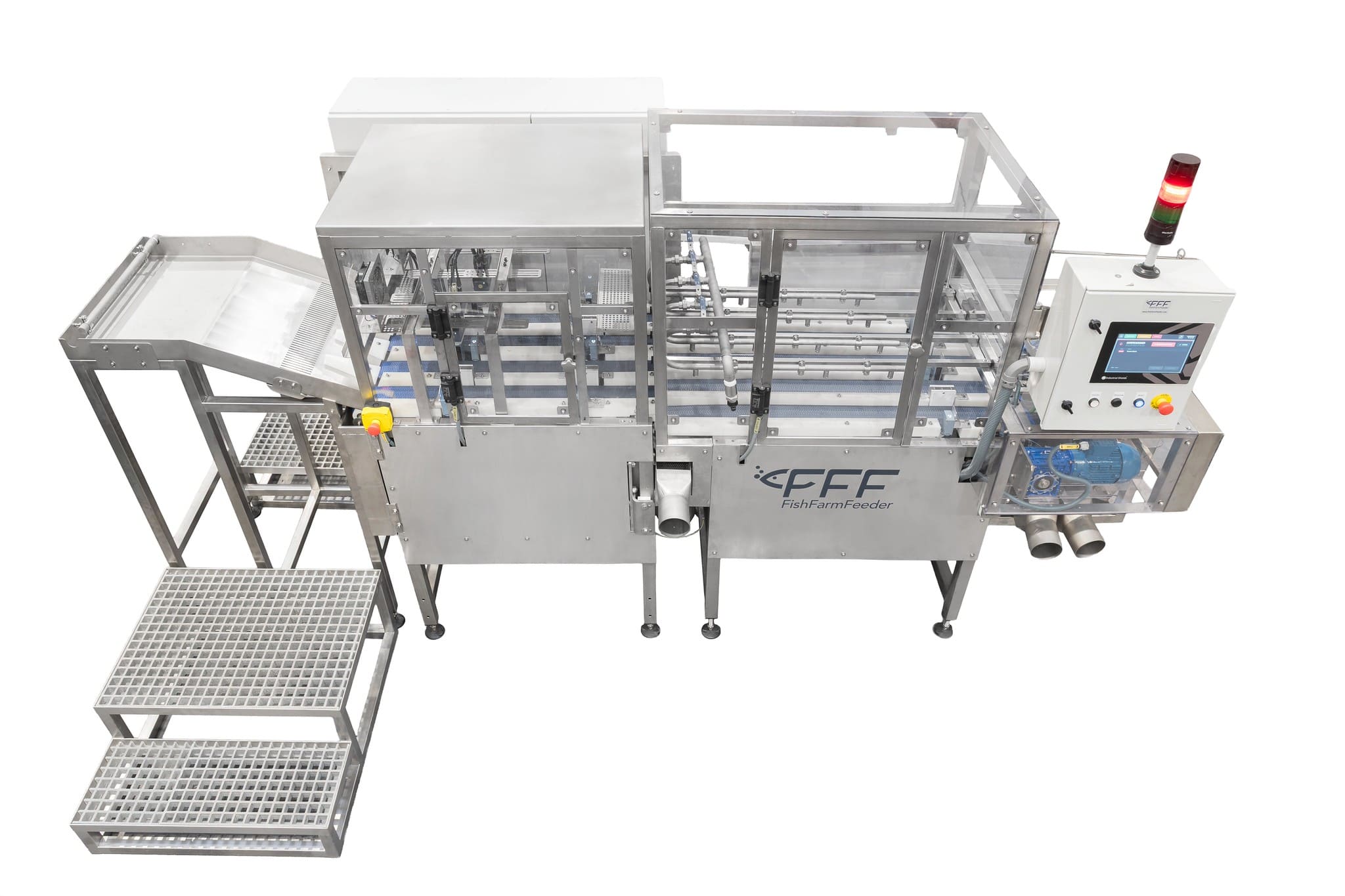
Based on that calibration, the system automatically displays the population spread and gives the operator a clear view of how the fish are distributed in terms of size. From there, the user defines the three working categories — small, medium, and large — according to the biological and operational criteria of the farm. This is a major advantage, because grading thresholds are not imposed by the machine: they are defined by the user to match the reality of each batch.
Once these size ranges have been established, the grading process can begin. Fish are fed into the machine and processed individually across the four classification channels. FLATCLASS uses the calibration data previously generated to assign each fish to the correct size segment, while also recording its measured length, width, and estimated weight. Each fish is then automatically routed to the selected destination according to the grading configuration defined by the operator.
This workflow gives producers a flexible and practical way to adapt grading to each fish population, ensuring that classification is not only automated, but also aligned with the biological variability of the batch being handled.
More than grading: real biomass intelligence
One of the most powerful benefits of FLATCLASS is its ability to go beyond visual sorting. The system performs individual biomass estimation with 99.9% accuracy, turning each processed fish into a reliable source of biological data.
This means that producers do not just know how many fish were sent to each size group. They also gain visibility into the estimated biomass of each unit processed, helping them improve stock assessment, monitor growth more precisely, and support planning decisions with better data.
In practice, this creates a smarter grading operation: one that not only separates fish, but also generates information that can improve the management of the entire production cycle.
Traceability built into the process
Today, aquaculture operations increasingly need traceable and accessible data. FLATCLASS has been designed with this need in mind.
The system allows the operator to select the origin tank and destination tank during the grading process, ensuring that each classification event is linked to its production context. Combined with the automatic recording of fish measurements and estimated biomass, this creates a valuable digital trace of each batch processed.
In addition, FLATCLASS offers remote data access, opening the door to stronger traceability, better historical analysis, and greater production transparency. For producers, this means not only better visibility on what happens during grading, but also better control over the data that supports future decisions.
Why FLATCLASS makes a difference
Fish Farm Feeder developed FLATCLASS to answer a clear market need: flatfish producers require grading systems that are not only fast, but also intelligent, adaptable, and capable of generating operational value.
FLATCLASS delivers exactly that.
It helps reduce variability associated with manual grading, increases process consistency, and gives the user control over how size categories are defined. Instead of working with rigid preset thresholds, producers can calibrate the system according to the real biological distribution of each batch. This makes the grading process more meaningful from a farming perspective and much more useful operationally.
At the same time, the combination of high throughput, accurate classification, individual biomass estimation, and data traceability positions FLATCLASS as a next-generation solution for hatcheries looking to modernize their workflows.
Designed for producers who want more than automation
Automation alone is no longer enough. Producers want systems that help them make better decisions, improve stock uniformity, and turn daily operations into measurable performance.
That is the philosophy behind FLATCLASS.
By integrating smart grading, operator-defined size segmentation, biomass estimation, and digital traceability into one single platform, FishFarmFeeder offers a solution that is practical on the production floor and strategic at the management level.
The future of flatfish grading is already here
As aquaculture moves toward greater precision and digitalization, grading systems must evolve as well. FLATCLASS represents that evolution: a smarter way to classify juveniles, monitor biomass, and build traceable production data from the very start of the growing cycle.
For hatcheries and nurseries working with flatfish, FLATCLASS is more than an equipment upgrade. It is a new way to understand and manage juvenile grading.
FishFarmFeeder FLATCLASS: accurate grading, intelligent biomass estimation, and smarter traceability for modern aquaculture.

Javier Álvarez Osuna is a director of R&D and information technologies at FFF.
His 30 years of professional activity have been developed mainly in the technological field and specifically in R&D. He has been a Torres Quevedo researcher (2009) and his merits include participation in more than 25 R&D projects and management of another 10 as principal investigator.
He is the author of 10 international articles and holder of 2 international technological patents. He is an expert in the development of embedded systems and software for industrial environments that require high performance.
Doctor in Pharmacy – the University of Santiago de Compostela (1997).