Recirculating Aquaculture System (RAS): Revolutionizing Land-Based Fish Farming
What Is a Recirculating Aquaculture System?
A Recirculating Aquaculture System (RAS) is a land-based, closed-loop aquaculture technology designed to rear fish in a highly controlled environment. Unlike traditional open systems such as sea cages or freshwater ponds, a RAS system continuously treats and reuses the same water, drastically reducing water use and environmental impact. It is a modern solution for sustainable fish production, particularly for high-value fish species like Atlantic salmon.
RAS farms integrate advanced water treatment components—including mechanical filtration, biological filtration, UV disinfection, and degassing units—to maintain optimal water quality for fish growth. These systems are highly customizable and scalable, making them suitable for a variety of fish farms, from hatcheries to full grow-out facilities. As aquaculture production shifts toward environmentally responsible methods, RAS technology is becoming central to the development of next-generation farming systems.
The Role of RAS in Sustainable Fish Farmin
Recirculation aquaculture offers numerous advantages over conventional farming:
- Water efficiency: Up to 99% of water can be reused within the system.
- Biosecurity: Reduced exposure to pathogens compared to offshore aquaculture.
- Environmental protection: Controlled waste management limits pollution.
- Site flexibility: RAS can be located away from coastal areas, close to markets.
As land-based systems, RAS farms enable salmon and other fish species to be produced near urban centers, reducing transportation costs and the carbon footprint of seafood distribution.
Components of a RAS Setup
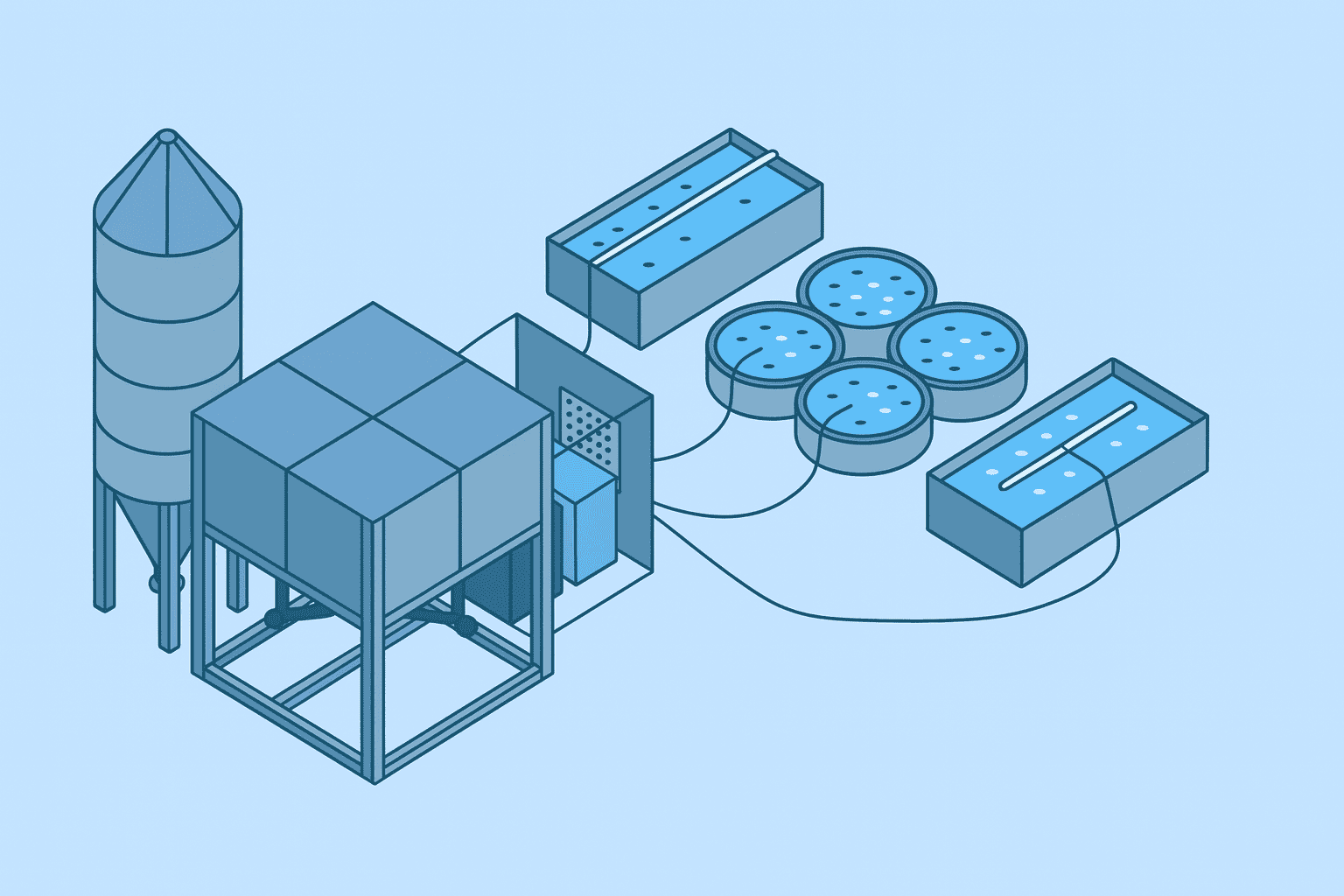
A typical RAS setup includes the following unit processes:
-
Solid Removal
-
Drum filters or radial flow separators capture suspended solids and uneaten feed.
-
Solids from the system are collected and removed to prevent clogging and ammonia buildup.
-
-
Biological Filtration
-
Biofilters host nitrifying bacteria that convert toxic ammonia (from fish waste) into less harmful nitrite and then nitrate.
-
Effective biological filtration is crucial to maintain stable nitrogen levels.
-
-
Degassing and Aeration
-
Degassing units remove carbon dioxide and nitrogen gas, which can accumulate in recirculation systems.
-
Aeration and oxygenation systems ensure sufficient dissolved oxygen for fish health.
-
-
Disinfection
-
UV or ozone systems disinfect culture water to control pathogens.
-
This step enhances biosecurity and reduces fish disease risks.
-
-
Water Reuse and Replacement
-
A small percentage (typically 5–10%) of water is replaced daily to balance mineral content and maintain water quality.
-
Water purification processes minimize waste water discharge and improve energy efficiency.
-
Fish Waste Management in RAS
One of the most important aspects of RAS technology is effective management of fish waste. Solid waste, including feces and uneaten feed, must be continuously removed to prevent water quality deterioration. The conversion of ammonia into nitrate is another critical function, achieved through a well-maintained biofilter. Proper management of nitrogen compounds, including nitrate, nitrite, and ammonia, is essential to protect fish health and avoid toxic buildup.
Advanced RAS farms also explore reuse of waste product as input for other systems, such as in aquaponics, where plant crops benefit from nutrient-rich water.
Aplicaciones en la cría de salmón atlántico
El RAS tiene el potencial de revolucionar la producción de salmón atlántico al trasladar la cría de jaulas marinas a tanques interiores. Productores noruegos han demostrado que la cría terrestre es técnica y económicamente viable.
Applications in Atlantic Salmon Farming
RAS has the potential to revolutionize Atlantic salmon production by relocating fish farming from sea cages to indoor tanks. Norwegian salmon producers have pioneered this model, demonstrating that land-based salmon farming is technically feasible and increasingly economically viable.
Benefits of RAS for salmon include:
- Control over temperature, lighting, and water parameters for optimal growth conditions.
- Elimination of sea lice and other marine parasites.
- Year-round production in a controlled environment regardless of external conditions.
Land-based salmon RAS farms are now in development in North America, Europe, and Asia, backed by both public research and private investment.
Environmental Impact and Energy Efficiency
While RAS offers significant sustainability benefits, it also has challenges:
- Energy requirements for water treatment and circulation are high.
- Cooling systems are often necessary, depending on species and climate.
- Energy consumption must be balanced with renewable energy options to maintain the system’s environmental advantage.
Nonetheless, RAS significantly reduces greenhouse gas emissions from transport, feed losses, and ecosystem degradation associated with open-water aquaculture.
Fish Health and Stocking Density
Because RAS operates in a controlled aquatic environment, it allows for precise management of stocking density, water temperature, and disease control. Fish health is monitored continuously through automated sensors and manual checks. These conditions support faster fish growth and reduce losses from disease outbreaks.
Indoor tanks or raceways are designed to simulate optimal rearing conditions, minimizing fish stress and improving welfare. Vaccination and low-stress handling techniques are often employed in these intensive farming systems.
Economic Considerations and RAS Expansion
While RAS farms require high capital investment, the long-term economic benefits include:
- Proximity to consumer markets, reducing logistics costs.
- Predictable production cycles and harvest volumes.
- Premium market positioning for land-based, environmentally sustainable fish.
Government agencies like NOAA and industry bodies support RAS expansion through research funding, technical assistance, and sustainable aquaculture policy development. As part of broader aquaculture development, RAS technology is expected to play a growing role in securing food systems.
Integration with Aquaponics and Circular Systems
Recirculating aquaculture systems are increasingly integrated into circular economy models:
- Aquaponics systems combine fish rearing with hydroponic plant cultivation.
- Fish waste provides nutrients for crops, reducing need for synthetic fertilizers.
- These systems enhance overall resource use and sustainability.
RAS technology thus contributes to broader sustainable food production goals, aligning with consumer demand for low-impact, traceable, and ethically produced seafood.
Recirculating aquaculture systems represent a transformative shift in how fish are farmed. By creating highly efficient, land-based farming systems that reuse water and minimize waste, RAS offers a sustainable solution to the challenges of modern aquaculture. As innovation continues and costs decline, RAS is set to become a cornerstone of global aquaculture production, particularly for high-value species like Atlantic salmon.
With continued development, strong biosecurity, and reduced environmental impact, RAS systems are redefining the future of fish farming.