Advances in Aquaculture: Smart Feeding, Technology and Farmed Fish Welfare
Aquaculture is undergoing a significant transformation. The growth of global production, the need to use resources more efficiently, and the challenges posed by climate change are accelerating the adoption of technology, automation and monitoring systems across aquaculture farms.
The FAO report The State of World Fisheries and Aquaculture 2026 (SOFIA 2026) highlights the importance of innovation, science, technology and improved management in advancing the sustainable transformation of aquatic food systems.
At the same time, the European Union is paying increasing attention to farmed fish welfare, the development of welfare indicators and the use of data and new technologies to improve farm management.
Together, these developments are shaping a new generation of aquaculture facilities: more connected, automated, closely monitored and increasingly reliant on data-driven decisions.
1. Aquaculture needs to produce more efficiently
Aquaculture continues to play an increasingly important role in global food production. However, the sector’s growth also brings challenges. Farms must improve productivity without proportionally increasing their consumption of feed, water, energy and other resources.
The future of aquaculture is therefore not simply about producing more. It is about producing more efficiently and sustainably.
SOFIA 2026 highlights the importance of technological innovation and improved management in developing sustainable and resilient aquaculture systems. These priorities are driving technological change across virtually every stage of production.
2. From experience to data-driven aquaculture
For decades, many decisions on aquaculture farms have relied heavily on the experience and expertise of farmers. That experience remains essential, but it can now be supported by increasing amounts of data collected through sensors, monitoring equipment and digital management systems.
Parameters such as water temperature, dissolved oxygen, fish behaviour, mortality, growth and feed conversion can provide valuable information for decision-making.
The objective is to move from a traditional approach based on observation and experience towards a more systematic process:
Measure → analyse → predict → act.
Digitalisation also makes it possible to store historical information, compare production cycles, identify deviations and refine management strategies over time.
3. More efficient feeding: a major challenge for aquaculture
Feeding is central to the economic and environmental performance of an aquaculture farm.
Providing high-quality feed is important, but so is managing when, how much and how often it is delivered.
FAO identifies feed availability, quality and management as fundamental factors in improving aquaculture production. Its initiatives include improving feed formulation, nutritional quality and on-farm feed management, while encouraging more efficient resource use.
Poor feeding management can lead to excessive feed delivery, unnecessary waste and less efficient resource utilisation. By contrast, a more precise feeding strategy can help align feed supply with the needs of the animals.
This is where automatic feeding systems become particularly valuable.
4. Automatic feeding: greater precision and control
Automatic feeders allow farmers to programme feeding schedules and distribute feed in a controlled and consistent manner.
This is particularly useful in facilities where fish require multiple feeding events throughout the day or where production volumes make accurate manual feeding difficult.
Automatic feeding systems can help farms to:
- Control the quantity of feed delivered more precisely.
- Distribute feed at different times throughout the day.
- Adapt feeding programmes to individual tanks, ponds or cages.
- Reduce repetitive manual tasks.
- Improve consistency in feeding operations.
- Support more systematic feed management.
However, the evolution of feeding technology goes beyond scheduling.
The next step is to integrate automatic feeders into a connected production management system, where feeding becomes part of a wider strategy for monitoring and improving farm performance.
5. Connecting feeding with farm data
The greatest opportunities emerge when automatic feeding is integrated with other monitoring and management technologies.
Environmental sensors and observation systems can provide information that helps farmers assess production conditions and refine their feeding strategies.
Fish behaviour is another important source of information.
The European report on farmed fish welfare identifies mortality, water temperature, dissolved oxygen and fish behaviour as parameters commonly monitored by operators, particularly during feeding and handling.
This creates an important opportunity: using information about fish behaviour to support better feeding decisions.
Rather than treating feeding as an isolated process, farms can increasingly integrate it into a broader system for monitoring and managing production.
6. Fish behaviour as a source of information
Observing fish has always been an important part of aquaculture management. New technologies, however, make it possible to monitor behaviour more systematically.
Cameras, sensors and analytical tools can help identify changes in behaviour that might be difficult to detect through occasional manual observations.
The European Commission’s work on farmed fish welfare includes the development and collection of good practices and indicators for assessing fish welfare across different production systems and stages.
Indicators may relate to behaviour, feeding, growth, water quality and other aspects of fish welfare.
As these technologies develop, behavioural monitoring could become an increasingly valuable tool for refining feeding strategies and improving day-to-day farm management.
7. Feeding efficiency and fish welfare are closely connected
Appropriate feeding affects more than growth. It is also related to the overall condition of farmed fish and to several indicators used to assess production performance and welfare.
The European report notes that some farms use the feed conversion ratio (FCR) and behavioural observations as indicators when assessing production conditions and, indirectly, aspects of fish welfare.
FCR measures the amount of feed required to produce a given amount of biomass. Monitoring it helps farmers evaluate feed utilisation and identify opportunities to improve production efficiency.
However, FCR alone does not provide a complete assessment of fish welfare. It should be considered alongside behavioural, environmental and health indicators.
The broader lesson is that production efficiency and fish welfare should be considered together.
A better understanding of fish behaviour and feeding performance can help farmers make more informed decisions about feed delivery, handling and environmental conditions.
8. Fish welfare is becoming a greater priority in Europe
Fish welfare is receiving increasing attention across the European aquaculture sector.
The European report on farmed fish welfare highlights differences between countries and farms in legislation, monitoring practices, indicators and implementation.
Although many operators monitor basic parameters such as mortality, water temperature and oxygen levels, the report indicates that welfare is not yet systematically integrated into operational control processes across the sector.
Technology can help address this gap by making it easier to collect consistent information and monitor changes over time.
Automated monitoring, digital records and improved observation methods can support more systematic management. Their effectiveness, however, depends on selecting appropriate indicators and translating the information into practical action.
9. Sensors and real-time monitoring
Water quality is a critical factor in aquaculture. Changes in environmental conditions can directly affect fish health, growth and feeding behaviour.
Sensors make it possible to monitor parameters continuously rather than relying exclusively on manual measurements taken at specific times.
Depending on the production system, these parameters may include:
- Dissolved oxygen.
- Water temperature.
- pH.
- Salinity.
- Turbidity and other water-quality indicators.
Connected monitoring systems can help operators identify deviations, generate alerts and respond more quickly to changing conditions.
When combined with feeding equipment and farm management software, these technologies can support a more integrated approach to production control.
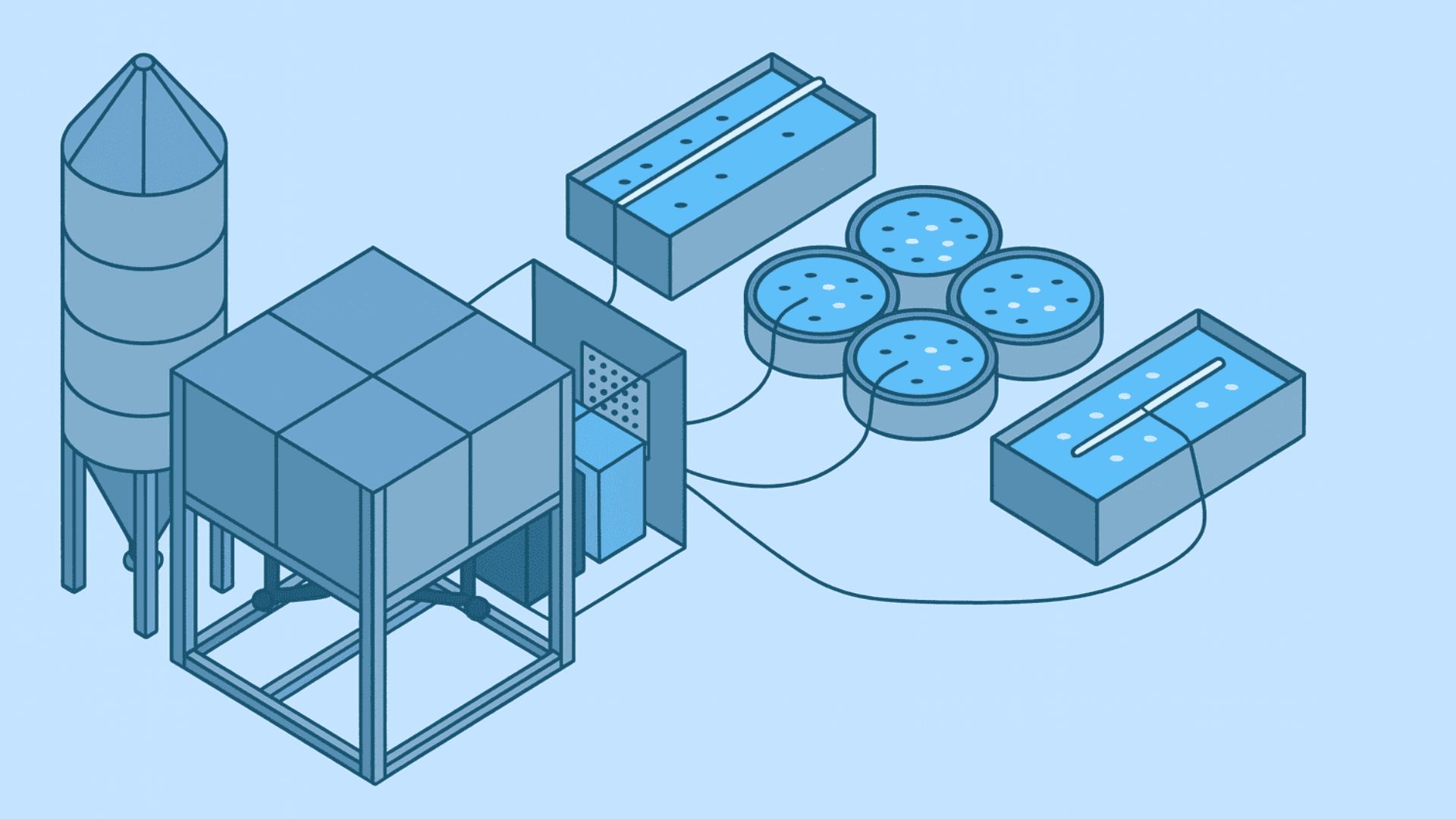
10. Recirculating aquaculture systems and production control
Recirculating Aquaculture Systems (RAS) are another example of how technology can increase control over the production environment.
These systems treat and reuse water, making water treatment, environmental monitoring and energy management essential to their operation.
As production becomes more intensive, reliable data and the ability to respond quickly to changing conditions become increasingly important.
RAS facilities are therefore closely associated with the wider development of automated and digitally managed aquaculture.
Nevertheless, the benefits of these systems depend on effective management. Water treatment, oxygen supply, temperature control and energy consumption must all be considered when evaluating overall farm performance.
11. Climate change makes efficiency even more important
Aquaculture must also adapt to changing environmental conditions.
SOFIA 2026 addresses climate adaptation as an important challenge for aquatic food systems. FAO has developed the Aquaculture Adaptation Framework for Climate Change (Aqua-Adapt) to help identify climate-related risks, assess vulnerabilities, develop adaptation plans and monitor their implementation.
Among the recommended actions are the adoption of adaptive technologies, improvements in feed efficiency and the transition towards renewable energy.
These priorities show that efficiency is not simply an economic objective. It is also part of building more resilient aquaculture operations.
Monitoring systems, improved management and automation can contribute to this process by helping farms use resources more effectively and respond to changing conditions.
12. Feeding management as part of sustainable aquaculture
13. From automation to smart aquaculture
Several technological developments are now converging to transform aquaculture operations.
A modern farm may combine:
Sensors + data + software + automation + farming expertise.
Automatic feeding systems can form part of this connected environment rather than operating as isolated pieces of equipment.
The objective is to use available information to improve operational decisions, maintain consistent processes and identify opportunities for optimisation.
Depending on the equipment and level of integration, this may include programmed feeding, environmental monitoring, digital records, automated alerts and data-supported feeding adjustments.
The direction is clear: more information, better control and greater opportunities to turn data into practical decisions.
14. What is the future of aquaculture?
The latest FAO and European reports point towards several closely connected priorities for the future of the sector.
Precision
Using feed, water, energy and other resources more effectively.
Automation
Reducing repetitive manual work and improving consistency in farm operations.
Digitalisation
Turning operational information into data that can be analysed and used to improve management.
Fish welfare
Developing and applying indicators that provide a better understanding of the condition of farmed fish.
Resilience
Preparing farms to respond to environmental variability and climate-related challenges.
Sustainability
Producing aquatic food responsibly while improving the use of available resources.
These developments are not independent of one another. The greatest benefits can emerge when technologies and management practices are combined to address the specific needs of each farm.
The future of aquaculture will be smarter
The transformation of aquaculture does not depend on a single technology. It will result from the integration of sensors, monitoring systems, data analysis, automation and improved production management.
Within this transformation, feeding has a strategic role.
Automatic feeding is not simply about distributing feed without manual intervention. It is about moving towards feeding processes that are more precise, more consistent and better integrated with the needs of the farm.
FishFarmFeeder: automatic feeding solutions for modern aquaculture
At FishFarmFeeder, we develop automatic feeding systems for aquaculture, designed for different species, production systems and farm requirements.
Automation gives farmers greater control over feed delivery and can support more consistent and efficient feeding operations. It is an important component of the wider transition towards more connected and digitally managed aquaculture.
As the sector continues to evolve, the integration of feeding technology with monitoring and farm management will create further opportunities to improve production practices.
The next generation of aquaculture will be more precise, more connected and more intelligent. And feeding technology will play an important role in that transformation.Grow your business with innovative feeding systems.
Start improving your profitability today.
From land-based fish farms to offshore systems, Fish Farm Feeder develops automated solutions tailored to every environment. Our technology enhances operational efficiency, optimizes resources, and maximizes your business profitability.
FishFarmFeeder
FishFarmFeeder is a leading company specializing in the design, development, manufacturing, and marketing of automated feeding systems for aquaculture. With an international presence across Europe, the Americas, Asia, and the Middle East, the company develops technological solutions aimed at optimizing resources in aquaculture farms.
The articles published under this firm represent the knowledge accumulated over the past 15 years dedicated to advancements in aquaculture innovation and sustainability.
- FishFarmFeeder
- FishFarmFeeder
- FishFarmFeeder
- FishFarmFeeder