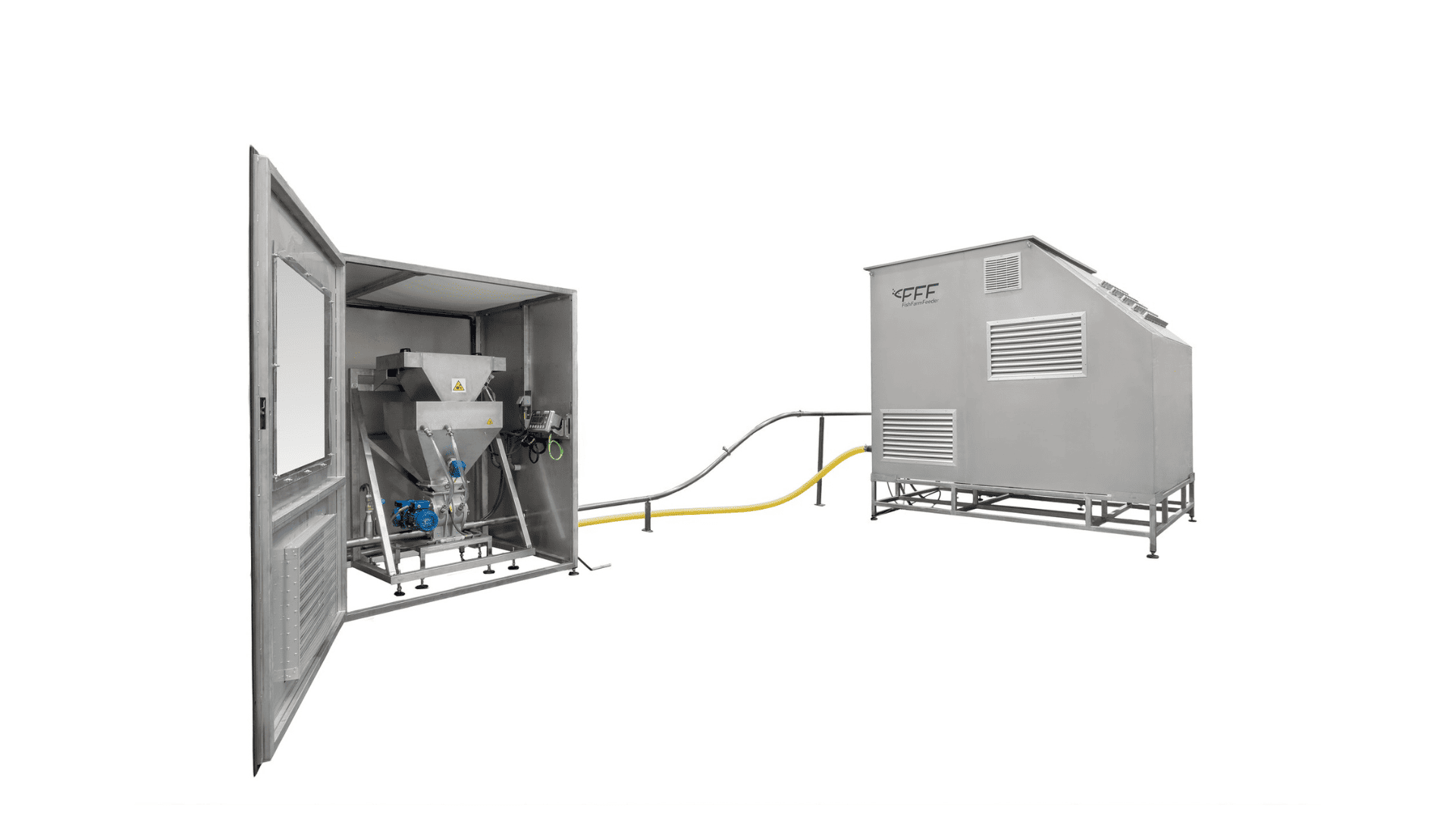
When designing an aquaculture feeding system, one of the most important decisions is choosing how each feed dose will be generated. Accuracy, operating speed, investment cost, and maintenance requirements depend largely on the selected dosing system.
At Fish Farm Feeder, we develop both volumetric and gravimetric dosing solutions, allowing each installation to be tailored to the specific needs of the farm. However, to make the best decision, it is essential to understand the advantages and limitations of each technology.
The two most commonly used dosing systems in aquaculture
Currently, most automatic fish feeding systems use one of these two methods to generate the feed doses.
Volumetric dosing
Volumetric dosing calculates the amount of feed based on the volume supplied, usually by controlling the operating time and rotation speed of a dosing element.
At Fish Farm Feeder, we primarily use high-precision augers, although rotary valves can also be used in certain applications. The system is pre-calibrated to determine the amount of feed dispensed over a specific operating time.
Its main advantages include:
- High dosing speed.
- Reduced mechanical and electronic complexity.
- Lower investment cost.
- Reduced maintenance requirements.
For these reasons, it is a technology widely used in nurseries, hatcheries and pre-growing systems where thousands of small doses are made every day.
Gravimetric dosing (by weighing)
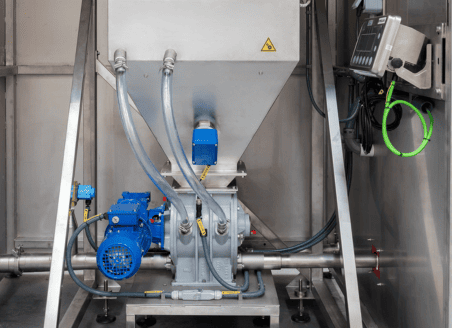
Gravimetric dosing is based on the actual weight of the dispensed feed. This is achieved using high-precision load cells that allow for the exact measurement of the feed quantity before it is distributed.
This system requires a more sophisticated mechanical and electronic architecture, since the feed must be collected, weighed, and then sent to the distribution point.
Its main advantage is the maximum precision in generating each dose, regardless of any variations that may exist in the density or physical characteristics of the feed.
Working speed: a key factor in production
Dosing speed is one of the most critical aspects of any aquaculture facility.
In breeding centers, hatcheries, and pre-growing phases, it is common to perform a high number of daily feedings with relatively small quantities. In these cases, the speed at which each dose is generated can limit the overall capacity of the system.
Volumetric systems generate the dose while calculating it, allowing for very high working speeds.
In contrast, gravimetric systems need to complete the weighing process first before sending the dose to the feeding point, which increases the time required for each cycle.
When the goal is to maximize the number of daily doses, volumetric dosing often offers a significant advantage.
Calibration and accuracy
Accuracy is usually the main argument in favor of gravimetric systems, but it is important to analyze this aspect in detail.
Calibration
All dosing systems require some type of calibration.
In volumetric systems, recalibration is recommended when factors such as the following change:
- Feed type
- Manufacturing batch
- Pellet size
- Feed density
These variations can slightly alter the amount delivered per revolution of the screw conveyor.
In contrast, gravimetric systems require minimal recalibration, as the actual weight is continuously measured by load cells.
Real precision
Gravimetric systems offer the highest possible accuracy by working directly with the measured weight.
Modern, properly calibrated and designed volumetric systems typically achieve accuracies between 95% and 99%, depending on the type of feed, pellet size, and dosage.
In many aquaculture applications, this difference is practically irrelevant compared to the operational advantages of increased processing speed.
Comparison between volumetric and gravimetric dosing
Feature | Volumetric dosing | Gravimetric dosing |
Speed | High | Average |
Investment costs | Lower | Higher |
Maintenance | Lower | Higher |
Precision | 95–99 % | Maximum |
Mechanical complexity | Low | High |
Need for calibration | Higher | Very low |
| Excellent | Limited |
Which system to choose?
There is no one-size-fits-all solution for every installation.
If the priority is high daily feed volume, minimizing costs, and simplifying maintenance, volumetric dosing is usually the most efficient option.
On the other hand, when absolute precision is a critical process requirement, gravimetric dosing provides the highest level of accuracy thanks to direct control of the dispensed weight.
At Fish Farm Feeder we design systems capable of integrating both technologies, helping each client to select the solution that best suits their production goals, farmed species and feeding strategy.
Conclusion
The choice between volumetric and gravimetric dosing should not be based solely on the system’s theoretical accuracy. Factors such as operating speed, feeding frequency, operating costs, and maintenance can have a much greater impact on the overall performance of an aquaculture facility.
Therefore, the best system will always be the one that offers the right balance between accuracy, productivity, and profitability for each project.